Mini Cooper Electric Hatch E vs Honda e: A Battle of Urban Electric Icons
While they are compact electric hatchbacks, they are different and exceptional in their approaches to range, performance, and technology. Mini Cooper Electric was fun to drive, and that tradition continues in the electric age for the fun and premium compact. The Honda e is a striking demonstration of minimalist design and futuristic digital technology tailored to the urban dweller with a passion for technology. This battle compares Mini’s iconic driving experience and heritage to Honda’s cutting-edge vision and practicality, pitting two of the most interesting urban EVs available today in an exciting duel.
This Mini Cooper Electric Hatch E and Honda e 2025 review will cover every inch of these electric legends. We’ll compare their design philosophies, performance specifications, and innovative technologies to help you determine which is best suited to entertaining you in the city. It is a classic personality versus clean-sheet design battle, where both cars offer compelling arguments for being the best city car.
- Characterful: Mini’s fun-to-drive heritage meets sporty, clean Honda minimalism with futuristic tech-focus.
- Urban Agility: Designed to make urban and suburban driving a breeze, both vehicles respond quickly on the road and have a small footprint.
- Modern Technology: Take advantage of the latest infotainment, driver aids, and connectivity features designed for today’s lifestyle.
- Zero Emission Performance: With instant acceleration and a quiet drive, your daily drive can be more enjoyable and the air more pure.
Quick Recap
Here is a brief overview of what sets the Mini Cooper Electric Hatch E and Honda e apart.
Mini Cooper Electric Hatch E
- Brand: Mini (BMW Group)
- Model Year: 2025
- Body Style: 3-door hatchback
- Trim/Variant Availability: Cooper E, Cooper SE
- Interior and Exterior: Characteristic Mini design language with modern EV elements, a rounded central display, and adjustable ambient lighting. Has clean, minimalist lines, and the Union Jack tail lights are a hallmark.
- Driving and Performance: Go-kart riding, instant acceleration, and a firm yet compliant ride.
- Drivetrain Configuration: Single electric motor driving the front wheels.
- Technologies Features: Big round OLED infotainment screen, “Mini Experience Modes”, high-level driver-assistance systems.
- Expected Price Range: To be priced from around £ 30,000.
Honda e
- Manufacturer: Honda
- Model Year: 2025
- Body Type: 5‑door hatchback
- Trims/Variants Available: Honda e, Honda e Advance
- Interior and Exterior Style: Retro-futuristic, clean, sleek, minimalist with smooth white surfaces, pop-out door handles and a top-to-bottom digital dash across the width of the car.
- Performance and Driving Experience: Rear-wheel-drive for an exceptionally tight turning circle, a comfortable ride and smooth power delivery.
- Powertrain: Rear wheels driven by a single electric motor.
- Innovations & Features: Dual-screen, full-width infotainment system, Side Camera Mirror System, single-pedal control.
- Price Range: Expected to be from £37,000.
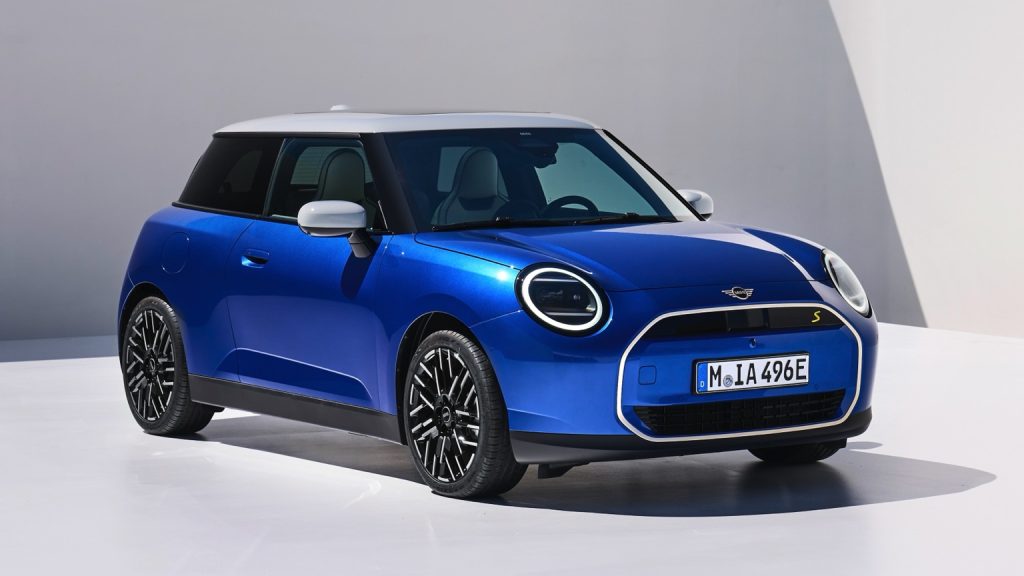
Cooper Electric Hatch E: Overview & Design Inspirations
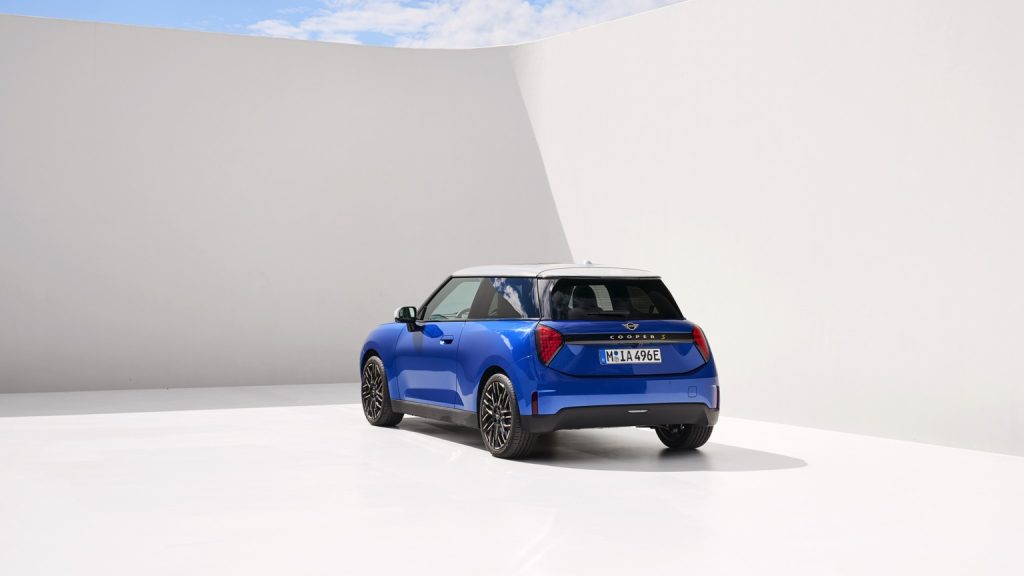
While the design and engineering philosophies of the Mini Cooper Electric and Honda e are polar opposites, they both feel perfectly suited to their purpose. Mini has followed a path of evolution based on its extensive heritage. The ‘Charismatic Simplicity’ brand mantra is alive and well in the all-new Cooper Electric. It has the familiar classic proportions, short overhangs, a contrasting roof, and round headlights that have represented the Mini for years and years. But it streamlines the aesthetic with flush planes, clean details and takes away the chrome, resulting in a contemporary, but immediately recognisable, profile. It rides on a dedicated EV platform co-developed with Great Wall Motor that is designed to maximise space with the agile, “go-kart” handling that is quintessential Mini.
Conversely, the Honda e is a truly revolutionary concept made this time around≫. It takes its design cues from the first-generation Civic, only with a digital future. Honda’s engineers literally had carte blanche to design the ideal for an urban commuter in both form and function, a unique rear-wheel-drive platform. That choice was defining, resulting in an incredibly tight turning radius of just 4.3 metres, ideal for urban manoeuvres. The outside is deliberately clean and friendly with smooth, clutter-free surfaces, round LED lights and the innovative Side Camera Mirror System in place of conventional wing mirrors. Human-centric function and the digital world play an integral role in the design of the car and the fluid connection that exists between the driver, the car and the digital world.
It’s always interesting to watch this clash between two cars that are aimed at very similar demographics, yet take completely opposing priorities. Mini Cooper Electric is for the buyers who prioritise the legacy of the brand and sporty driving experience; the design is a nod to the past, perfected for the present. It draws both younger drivers who want a slice of its timeless cool and older drivers who still appreciate the premium feel and performance of it. Meanwhile, the Honda e captures the hearts of tech-savvy users and those who appreciate pure design. Its sleek, almost abstract design with clipped corners is targeted at a younger, progressive demographic that values future thinking more so than tradition. They are often compared not only in size and capacity, but in ethos: one as the evolution of an icon, the other as a revolution in city transport.
- Timeless vs. Futuristic: The Mini evolves its iconic design, while the Honda e presents a bold, minimalist vision of the future.
- Heritage-Driven Performance: Mini’s engineering preserves its famous go-kart handling for an engaging drive.
- Innovation-Led Functionality: Honda’s bespoke rear-wheel-drive platform delivers unparalleled urban agility and a smooth ride.
- A Clash of Philosophies: The choice between these cars reflects a preference for either legacy and sportiness or technology and minimalist design.
Variants & Trims Breakdown: Cooper Electric Hatch E
What is not as obvious when comparing the Mini Cooper Electric vs the Honda e is the difference in their trim levels. Both brands have streamlined options, geared towards specific experiences.
Mini Cooper Electric Hatch E and Honda E Trims
| Trim | Key Features | Starting Price (Est.) | Value Proposition |
|---|---|---|---|
| Mini Cooper E | 40.7 kWh battery, 184 hp, 190-mile range (WLTP), 7.3s 0-62mph, 17-inch wheels, 9.4-inch circular OLED screen, basic driver aids. | £30,000 | The accessible entry into the premium electric Mini experience, offering iconic style and fun driving dynamics for the city. |
| Mini Cooper SE | 54.2 kWh battery, 218 hp, 250-mile range (WLTP), 6.7s 0-62mph, 18-inch wheels, augmented reality navigation, advanced driver aids. | £34,500 | The performance-oriented choice with a longer range, ideal for those who want more power and venture beyond the city. |
| Honda e | 35.5 kWh battery, 136 ps, 137-mile range (WLTP), full-width dual screens, Side Camera Mirror System, single-pedal control, 16-inch alloys. | £37,395 | A tech-loaded base model offering a futuristic driving experience with unique features as standard. |
| Honda e Advance | 35.5 kWh battery, 154 ps, 137-mile range (WLTP), adds Centre Camera Mirror System, premium audio, heated steering wheel, Honda Parking Pilot. | £39,895 | The fully-equipped model with added convenience and luxury features, enhancing the high-tech, premium feel. |
Different Variants Explained
The Mini Cooper E is the ideal jumping-off point. Its 184-hp motor has more than enough power for zippy urban jaunts, and its effortlessly-monitored 190-mile range is more than enough for daily runs. It offers the very essence of a Mini: the fun-to-drive handling, the chic styling and the innovative circular OLED display in a way that makes it surprisingly affordable. Upgrading to the Cooper SE gets you more power and notably more range. With 218hp and a 250-mile range, it elevates the Cooper Electric beyond a city-only ride to one suitable for long highway journeys. Larger wheels and quicker acceleration also lend a sportier feel, which brings it more in line with Mini’s performance heritage.
The Honda e range is simpler. The base model is a good start, with things like a full-width digital dashboard and camera-based mirror system. Its 136 PS motor and rear wheel drive system provide a smooth and refined driving experience suitable for city traffic. The Honda e Advance variant features a 154 ps motor for a bit quicker acceleration, but the range remains unreduced. Its true value is that convenience features such as the Honda Parking Pilot and a premium sound system make the cabin experience one of technological indulgence.
Spec Sheet Appendix
| Specification | Mini Cooper E | Mini Cooper SE | Honda e | Honda e Advance |
|---|---|---|---|---|
| Battery (usable) | 40.7 kWh | 54.2 kWh | 35.5 kWh | 35.5 kWh |
| Power Output | 184 hp (135 kW) | 218 hp (160 kW) | 136 ps (100 kW) | 154 ps (113 kW) |
| Torque | 290 Nm | 330 Nm | 315 Nm | 315 Nm |
| Range (WLTP est.) | 190 miles | 250 miles | 137 miles | 137 miles |
| 0-62 mph (0-100 km/h) | 7.3 s | 6.7 s | 9.0 s | 8.3 s |
| Top Speed | 99 mph | 106 mph | 90 mph | 90 mph |
| Drivetrain | Front-Wheel Drive | Front-Wheel Drive | Rear-Wheel Drive | Rear-Wheel Drive |
| Max DC Charging | 75 kW | 95 kW | 50 kW | 50 kW |
Note: Specifications are manufacturer-quoted and may vary by market and optional equipment.
Which one is easier to live with in 2025?
Living with an electric vehicle in 2025 requires looking beyond the initial charm of a retro design. While both cars capture the imagination with their style, daily usability often comes down to the mundane realities of range, charging speeds, and interior packaging. When we analyse these two icons side-by-side, clear distinctions emerge regarding which vehicle better supports a modern, active lifestyle.
Charging and Range Anxiety
The most significant differentiator between these two vehicles lies in their electrical architecture. By 2025 standards, range and charging speed define how flexible a car can be. The Honda e, with its capped 50 kW charging speed, feels restricted to strict city limits. While this speed is adequate for overnight home charging, it becomes a bottleneck during mid-day top-ups at public stations. Furthermore, the 137-mile range (WLTP) leaves little buffer for highway driving or cold-weather efficiency drops.
In contrast, the Mini Cooper SE offers a far more versatile experience. Its ability to accept up to 95 kW of DC fast charging allows you to replenish the battery much faster during quick stops. More importantly, the range of up to 250 miles fundamentally changes how you can use the car. It transforms from a purely urban runabout into a vehicle capable of weekend getaways without constant range anxiety. For drivers who need a primary vehicle rather than just a second city car, the Mini holds a clear advantage.
Interior Space and Practicality
Usability inside the cabin tells a different story, where the Honda e claws back points for accessibility. The Honda e features a five-door layout, making it significantly easier to load passengers, groceries, or child seats into the rear compared to the three-door configuration of the Mini Cooper. If you frequently carry rear passengers, the Honda’s extra doors eliminate the gymnastics required to access the Mini’s back row.
However, cargo space remains a challenge for the Honda. The boot is notably shallow, struggling to accommodate more than a couple of carry-on bags or a weekly grocery shop. The Mini, while harder to access for passengers, generally offers a deeper and more usable cargo area for luggage.
Daily Urban Usability
When navigating tight city streets, the driving dynamics play a crucial role in daily comfort. The Honda e utilises a rear-wheel-drive platform that allows the front wheels to turn at a sharper angle. This gives it an exceptionally tight turning circle, making U-turns and parking manoeuvres in cramped garages effortless. It is arguably the most manoeuvrable car for the densest urban centres.
The Mini retains its signature “go-kart” feel with front-wheel drive. While it is agile and fun, it lacks the ultra-tight turning radius of the Honda. However, the Mini’s infotainment and physical controls often feel more intuitive for quick adjustments while driving, whereas the Honda’s wall-to-wall screen dashboard, while impressive, can be distracting and complex to operate on the move.
The Verdict on Livability
Ultimately, the “easier” car to live with depends on your specific boundaries. If your life is strictly confined to the city centre and you value rear-seat accessibility, the Honda e offers unique charms. However, for the majority of drivers in 2025, the Mini Cooper Electric presents fewer compromises. Its superior range and faster charging speeds provide a safety net of convenience that the Honda simply cannot match, making it the more pragmatic choice for daily life.
Cooper Electric Hatch E: Performance & Driving Experience
In terms of the driving experience, the Mini Cooper Electric and Honda e give very strong, but different, feelings. The Mini retains its tradition of really putting the fun into driving, making it feel like a go-kart. And because of its front-wheel-drive orientation, low centre of gravity and direct steering, it’s as eager and nimble as you can imagine. The electric motor’s instant torque of 290 Nm in the Cooper E and 330 Nm in the SE makes it feel especially quick off the line. The Cooper SE’s 0-62 mph time of 6.7 seconds is actually not too bad for a small car and adds a touch of hot-hatch character to the car. The suspension is stiff, with handling and feedback from the driver’s side of the scale rather than comfort, which is ideal for someone who enjoys being connected to the road.
With the Honda e, drivers experience a driving dynamic that is totally different but just as fun. Its rear-wheel-drive layout is a boon for city driving. Not only does it have a beautifully balanced feel, but it also enables this phenomenal 4.3 metre turning circle to do U-turns in tight streets .” Ride Comfort and Refinement The suspension is significantly more supple and composed than that of the Mini, and the combination of springs, dampers and low-profile tyres absorbs road undulations with a level of sophistication that’s rather unexpected. Delivery of power. The power delivery is smooth and linear, and while it is not as quick as the Mini, the 315 Nm torque makes it feel responsive and capable in city traffic. Another highlight, the single-pedal control system makes easy and intuitive driving in stop-and-go traffic.
Both vehicles have driving modes that customise your experience. The Mini has “Mini Experience Modes” like “Go-Kart Mode,” which tightens throttle-response and steering for maximum fun, and “Green Mode” to maximise range. The Honda e includes a ”Sport Mode” which improves throttle response for a more lively feel, but the overriding consideration is to deliver a tranquil and effortless driving experience. In the end, the Mini is for the driver who wants every journey to be exciting and involving, and the Honda e is for the driver who appreciates comfort, refinement and clever engineering.
| Metric | Mini Cooper E / SE | Honda e / e Advance |
|---|---|---|
| Acceleration (0-62 mph) | 7.3s / 6.7s | 9.0s / 8.3s |
| Driving Feel | Agile, sporty, firm | Smooth, refined, comfortable |
| Primary Driving Mode | Go-Kart Mode (maximises fun) | Normal Mode (balances comfort and efficiency) |
| Secondary Driving Mode | Green Mode (maximises range) | Sport Mode (sharpens throttle response) |
- Engaging Handling: The Mini’s go-kart dynamics provide a fun and responsive drive.
- Urban Agility: The Honda e’s rear-wheel-drive setup and tight turning circle make it exceptionally easy to manoeuvre in the city.
- Refined Comfort: Enjoy a smooth and quiet ride in the Honda e, perfect for relaxing commutes.
- Customisable Experience: Both cars offer driving modes to switch between sporty performance and eco-friendly efficiency.
Cooper Electric Hatch E: Interior, Comfort & Technology
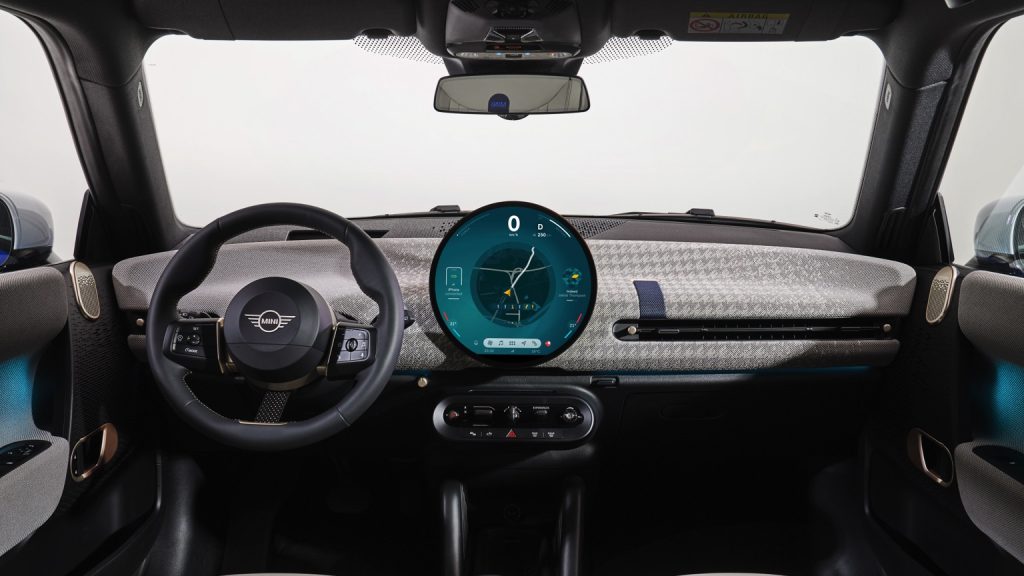
The Mini Cooper Electric and Honda e interiors are where the two cars really start to show their quirks. Mini has built a world that is whimsical and luxurious. The highlight is the world’s first circular OLED, an eye-popping 9.4-inch display that functions as the instrument cluster and infotainment centre. It is powered by Mini Operating System 9, delivering crisp graphics, easy-to-use controls, and funny animations. The instrument panel is covered with a bespoke recycled textile, and the entire concept is an inspired blend of vintage Mini hallmarks and contemporary minimalism. It has great ergonomics, a tight back seat, as you would expect, and a comfortable, commanding driving position in the front.
The interior of the Honda e is a triumph of simplicity and digital integration. Two 12.3-inch touchscreens that can be customised and even exchanged between driver and passenger make up the full-width digital display on the dash. This sets the lounge-like mood, which is reinforced by the use of soft, inviting fabrics and wood-effect trim. With the absence of a standard centre console, the space is disjointed, which helps make the room feel light and spacious. There is a focus on comfort, with seats that are wide and supportive. The most controversial feature, the Side Camera Mirror System, transmits video feeds to two 6-inch displays on the ends of the dash, reduces drag and provides a wider field of vision than traditional mirrors. From a technical perspective, both vehicles are top of the line. The Miniberliner’s system features a voice assistant, augmented reality navigation and the “Mini Experience Modes” that change the look of the screen and the ambient light. The Honda e answers with its dual-screen arrangement, enabling you to focus on navigation on one screen and media on the other, for instance. It also has an HDMI input so you can plug in a device like a games console. Both cars offer full advanced driver assistance systems (ADAS), so you can count on being safe and comfortable.
Exterior Design Comparison
| Feature | Mini Cooper Electric | Honda e |
|---|---|---|
| Colours | Vibrant palette including Blazing Blue, Sunny Side Yellow, and classic British Racing Green. | Minimalist options like Platinum White Pearl, Crystal Black Pearl, and the signature Charge Yellow. |
| Lighting Signature | Circular LED headlights with customisable DRL signatures; Union Jack LED tail lights. | Round, friendly LED headlights and tail lights integrated into black panels. |
| Aerodynamics | Flush door handles, smooth surfaces, and an aero-optimised rear spoiler. | Flush pop-out door handles, Side Camera Mirror System, and a clean, low-drag body. |
| Body Detailing | Contrasting roof and mirror caps, simplified octagonal grille, minimal chrome. | Clamshell bonnet, black accent panels front and rear, pillarless-look doors. |
- Iconic Central Display: The Mini’s circular OLED screen is a stunning and intuitive interface.
- Lounge-Like Cabin: The Honda e’s full-width dashboard and open layout create a spacious, relaxing environment.
- Cutting-Edge Tech: Both cars offer advanced features like voice control and comprehensive driver aids.
- Innovative Mirrors: The Honda’s camera system is a futuristic feature that improves aerodynamics and visibility.
Safety & Reliability
Security We are confident that both Mini and Honda take security very seriously, and both cars come with a good set of up-to-date security features. The new Mini Cooper Electric is based on a new dedicated EV platform that was engineered with crash safety in mind. Euro NCAP rating for the 2025 model is to be announced; the previous generation was rated with a very solid four stars, and Mini is aiming even higher with this new generation. Safety to standard: Multi airbags, Advanced Braking systems with ABS+EBD, and many Driver assistance features.
The Mini’s basic over-the-counter Driving Assistant pack includes things like Lane Departure Warning and Collision Warning with Front Assistant. Higher-level trims or available packages include Driving Assistant Plus, which adds Active Cruise Control with Stop & Go capability, and Steering Assistant, granting Level 2 semi-autonomous driving functionality for more comfortable highway driving. They rely on integrated cameras and radar sensors that work in unison to scan the road and alert the driver to possible dangers, greatly increasing your confidence behind the wheel.
The Honda e takes its four-star safety rating from Euro NCAP with excellent scores for the protection of adult and child occupants. Honda SENSING, the suite of Honda safety and driver-assistive technologies, is standard equipment on all trims. It contains the Collision Mitigation Braking System, Lane Keeping Assist System, Traffic Sign Recognition and Adaptive Cruise Control. The Lead Car Departure Notification System is a one-of-a-kind feature that notifies the driver (when distracted) that the car in front of them has started moving in traffic. The car’s rigid body and 360 camera also contribute to solid safety ratings, and the end result is a safe, dependable car that’s perfect for urban commuters.
- Comprehensive Airbag Systems: Both models feature extensive airbag coverage for all occupants.
- Advanced Driver-Assistance (ADAS): Standard features like automatic emergency braking and lane-keeping assist enhance safety.
- Semi-Autonomous Capabilities: Optional systems in the Mini and standard adaptive cruise in the Honda reduce driver fatigue on long trips.
- Proven Safety Ratings: The Honda e’s four-star Euro NCAP rating provides peace of mind.
Comparison Section
The Mini Cooper Electric and the Honda e are direct competitors, but they should also be considered against other good-looking city EVs. For comparison, here is how they compare to the Fiat 500e and the Peugeot e-208.
| Model | Price (Est.) | Performance (0-62mph) | Range (WLTP) | Design | Value & Target Buyer |
|---|---|---|---|---|---|
| Mini Cooper E | £30,000 | 7.3s | 190 miles | Sporty, iconic, premium | For those who prioritise driving fun and brand heritage. Offers a premium feel and engaging handling. |
| Honda e | £37,395 | 9.0s | 137 miles | Retro-futuristic, minimalist, tech-focused | For the tech-savvy urbanite who values design, innovation, and interior comfort over long-range capability. |
| Fiat 500e | £28,195 | 9.0s | 199 miles | Chic, retro, fashionable | An affordable and stylish alternative with a comparable range to the base Mini, appealing to fashion-conscious buyers. |
| Peugeot e-208 | £31,200 | 8.1s | 248 miles | Sharp, modern, aggressive | A practical and stylish choice offering a significantly longer range, appealing to buyers needing more versatility than a pure city car. |
This comparison illustrates the Mini and Honda’s sheer individuality. The Fiat 500e is vying for retro appeal at a much lower price point, so it’s a value play. But the Peugeot e-208, with five doors and a much longer range for a similar price to the base Mini, is a much more practical all-rounder, and as such it’s able to take both on.
It’s the driving experience that sets the Mini Cooper Electric apart and makes it worth the extra cost. It’s the city car you should get if you want it to be truly fun to drive. It may be more expensive and have a shorter range, but the Honda e finds its own space with its unmatched interior and technology offering. It is for the buyer who looks at their car as a piece of technology and design, a sanctuary in the city. The Honda is more of a gadget than a car, and for a certain buyer, that’s an irresistible proposition.
- Driving Fun vs. Tech Showcase: The Mini excels in performance and handling, while the Honda leads with its futuristic interior and features.
- Range Considerations: The Peugeot e-208 and long-range Mini SE offer greater versatility for those who frequently travel outside the city.
- Value and Style: The Fiat 500e provides a compelling, stylish package at a very competitive price point.
- Know Your Priorities: The best car depends on whether you value performance (Mini), technology (Honda), range (Peugeot), or price (Fiat).
Why choose the Mini Cooper Electric Hatch E or the Honda e?
The choice between these two city legends ultimately comes down to what you value most in a car. Both are excellent choices for their class, though they target different kinds of lifestyles and priorities. To pick one is to make a statement about what you want your daily driving experience to feel like.
The Mini Cooper Electric Hatch E is for the person who thinks that driving should always be an occasion. It is tailor-made for a lifestyle featuring spirited drives, whether daily driving through winding city streets or weekend getaways. Its combination of legendary styling and exhilarating performance makes every run a joy. Mini’s approach is clear: stay the premium fun-to-drive alternative in the small segment. The new fully electric version takes this even further by giving the car’s agility an extra boost with instant torque, all in a technologically advanced, customizable package. It’s the kind of car that stirs an emotional response in its driver.
Mini Cooper Electric Pros and Cons
Pros:
- Exceptional “go-kart” handling and engaging performance.
- Longer range option available with the Cooper SE (250 miles).
- Stunning and intuitive circular OLED infotainment system.
- Iconic design with modern, premium touches.
Cons:
- A firmer ride may not be for everyone.
- Limited rear passenger and boot space.
The Honda e is for a different type of city dweller. That person is the one who hustles through the city on a daily basis and wants a calm, intelligent and stylish refuge. It accommodates a lifelong coping mechanism that relies on technology, design, and effortless ease. Combine that with a smooth and nimble ride, and the result is an oasis for the soul amid the mayhem. Honda’s plan with the ‘e’ was that it would be a “halo” vehicle, one that demonstrates the brand’s technological, design, and engineering capabilities, without necessarily being high-volume. It’s a vehicle for early adopters and those who value thoughtful, human-centred design.
Honda e Pros and Cons
Pros:
- Revolutionary interior with a full-width digital dashboard.
- Extremely comfortable ride and an incredibly tight turning circle.
- Unique, minimalist design that stands out.
- Packed with innovative technology like the Side Camera Mirror System.
Cons:
- Limited driving range (137 miles) restricts it to city use.
- Higher price point compared to rivals with a similar range.
Which Compact Electric Hatchback Should You Buy? Mini Cooper Electric Hatch E vs Honda e
So, after this in-depth 2025 assessment, is the Mini Cooper Electric or the Honda e any good? The answer is a loud yes, but for different demographics. Both vehicles are outstanding examples of what a modern electric city car can look like, and the best one for you depends on what you want most.
If you are a driver first, someone who likes to have fun behind the volant and connect with their vehicle and the road, the Mini Cooper Electric Hatch E is the best choice. It takes the cherished Mini design and successfully brings it into the electric era. With its excellent range on the SE model and its exciting driving dynamics, it’s both a sensible and spectacular pick. It’s the car for people who want to feel delighted every time they get in their daily driver.
On the other hand, if you think of your car as a portable extension of your connected life and a refuge from the city chaos, the Honda e still can’t be beat. Its breakthrough interior design, peaceful ride quality and ingenious, city-specific solutions all add up to make it a truly remarkable automobile. That limited range is a big factor, and yet for the buyer who’s mostly driving in the city and prioritising design, the Honda e delivers an experience no other competitor comes close to. It’s a daring, handsome and savvy premium vehicle for the contemporary city dweller.
Don’t just read about innovation, drive it. Experience The.Car Cooper Electric Hatch E and feel the future at your fingertips.