BYD Dolphin SURF 43.2 kWh Boost 2025 vs Nissan Leaf: Which Small EV is Smarter to Buy?
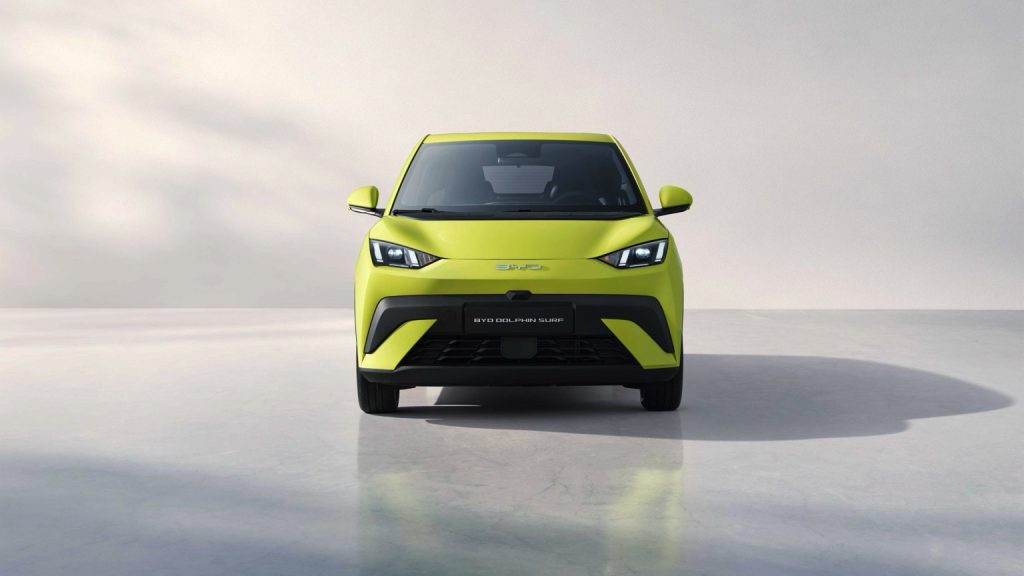
There is a lot of competition in the electric vehicle market these days; however, two models consistently feature among the top-selling: The Nissan Leaf and the BYD Dolphin. One is the established pioneer that made EVs popular, a household name that’s synonymous with reliability. The other is an insurgent, a technologically progressive company that is rapidly shattering the notion of what an inexpensive electric vehicle can be. This contrast creates an intriguing matchup between legacy and aspiration.
So in this Dolphin SURF 43.2 kWh Boost 2025 Review, we’re not just comparing two cars; we’re comparing two ideologies. The Nissan Leaf has been a standard-bearer for attainable, practical electric mobility. By contrast, the BYD Dolphin, and more specifically the sporty SURF 43.2 kWh Boost variant, makes its debut with a striking marine life-inspired design, revolutionary battery and a line-up of equipment that punches well above its weight. It is a new breed of concept, emphasising spirited performance and advanced technology.
This comparison will explain why these particular models are grabbing attention. The Leaf remains the go-to option, but the Dolphin’s arrival is a real game-changer. We’ll be going over their designs, real-world performance potential and technology inside the cabins. It’s a classic affordability vs legacy and innovation vs market dominance war. Come along as we find out which one of these electric titans offers the best all-around package for today’s driver.
Key Highlights: Dolphin SURF vs. Nissan Leaf
Before we get into this all-encompassing Dolphin SURF 43.2 kWh Boost 2025 Review in detail, here are some of the things that make each of those electric vehicles an interesting pick. This is an overview describing what it covers for the unique BYD Dolphin and the classic Nissan Leaf.
- Manufacturer: The Chinese BYD (Build Your Dreams), a tech giant in its own right, takes on the much older Japanese vehicle manufacturer Nissan with their mass-market vehicular production experience.
- Model Year: We’ve selected the latest 2025 versions of the BYD Dolphin and Nissan Leaf models to compare in this review for the freshest set of features and power.
- Body style: Both models are five-door hatchbacks designed to be practical and efficient in city life, but they both take a different approach when it comes to how roomy the interiors are and how the shells are designed.
- Trim/Variant: The Surf 43.2 kWh boost is a high-performance variant of the BYD Dolphin. The Nissan Leaf is also available in a variety of trims, which mainly differ in battery size and kWh levels.
- Interior and Exterior Designs: The Dolphin is designed for a playful marine-themed “Ocean Aesthetics” style, while the Leaf possesses a more traditional, albeit still modern, automotive look.
- Performance and Drivability: The Dolphin SURF Boost is built for quick and responsive acceleration, perfect for town traffic. The Leaf delivers a quiet, comfortable, and predictable driving experience that errs on the side of usability rather than speed.
- Powertrain Options: Both are electric front-wheel drive. The main difference is in BYD’s revolutionary Blade Battery technology as opposed to Nissan’s tried and true lithium-ion battery packs.
- Innovations & Features: The rotating central touchscreen and Vehicle-to-Load (V2L) capability make BYD stand out. Nissan possesses a solid reputation for the ProPILOT Assist system and EV dependability.
- Comparison: This tech-forward challenger goes up against a trusted incumbent. It’s a question of whether you want bells and whistles and a sexy design, or if you want tried and true dependability and straightforward usability in today’s world.
- Price Range: Both of these models are in the budget EV category, and when it comes to value for money, they are great contenders. The final price varies significantly depending on the chosen trim and battery size, with the Dolphin SURF 43.2 kWh Boost price competitively set to challenge the top of the market.
Engineering Philosophy: Where Ocean Meets Urban Legend
When you delve into this Dolphin SURF 43.2 kWh Boost 2025 Review, you will find that it is like two separate engineering philosophies that have come together at the same point, which is to provide available and high-value electric mobility.
BYD brings a new, blank-slate approach to the Dolphin. It is the first vehicle of their “Ocean Series,” which is based on the new dedicated e-Platform 3.0. This platform marks a technology breakthrough for the brand and will be fully leveraged on electric vehicles to enhance efficiency, safety, and interior space. This architecture, BYD calls a “cradle for the next generation of smart EVs,” revolves around integrating the battery into the chassis, called Cell-to-Body or (CTB) technology. It improves structural rigidity and permits a lower floor and better aerodynamic design. The “Ocean Aesthetics” design language is inspired by the fluid/dynamic lines of ocean creatures, which endows the automobile with distinctive youthful vitality.
Meanwhile, the Nissan Leaf is the evolution of a trailblazer. Its design ethos is one of polishing and familiarising its design as it became one of the first mass-market EVs. Nissan has designed the Leaf on a dedicated EV platform that emphasises a low centre of gravity and stability. Their approach to engineering is guided by “Intelligent Mobility,” a vision that shapes the way they develop products with an emphasis on achieving the goals of zero emissions and zero fatalities. The Leaf’s styling is crisper and more angular than previous models, with the use of Nissan’s signature V-Motion grille and a floating roof look. It seems like a mature product, built on more than a decade of real-world feedback, and its laser focus on aerodynamic efficiency lets it milk every kilometre from its charge.
BYD Dolphin SURF 43.2 kWh Boost Vs Nissan Leaf: Similarities and Differences
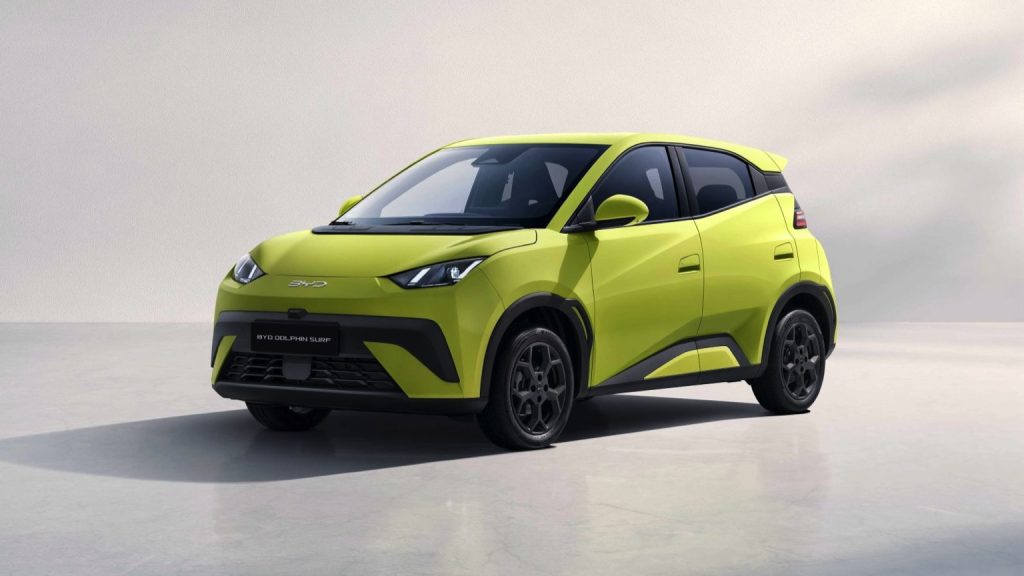
Although both cars are firmly anchored in the compact hatch segment, each visual treatment caters to a different buyer.
The BYD Dolphin SURF 43.2 kWh Boost features also a “playful tech” mood. Its shape is taller, nearly making it a cross between a regular hatchback and a mini-MPV. This height allows for a surprising amount of headroom and a sense of spaciousness in the cabin. The ‘SURF’ package typically highlights bold, dual-tone paint schemes and geometric shapes, which are meant to mimic the look of dolphins leaping out of the sea. It’s a look that screams new tech fun and is no doubt aimed at a younger crowd or those who see their car more as a lifestyle, a radical gadget on wheels.
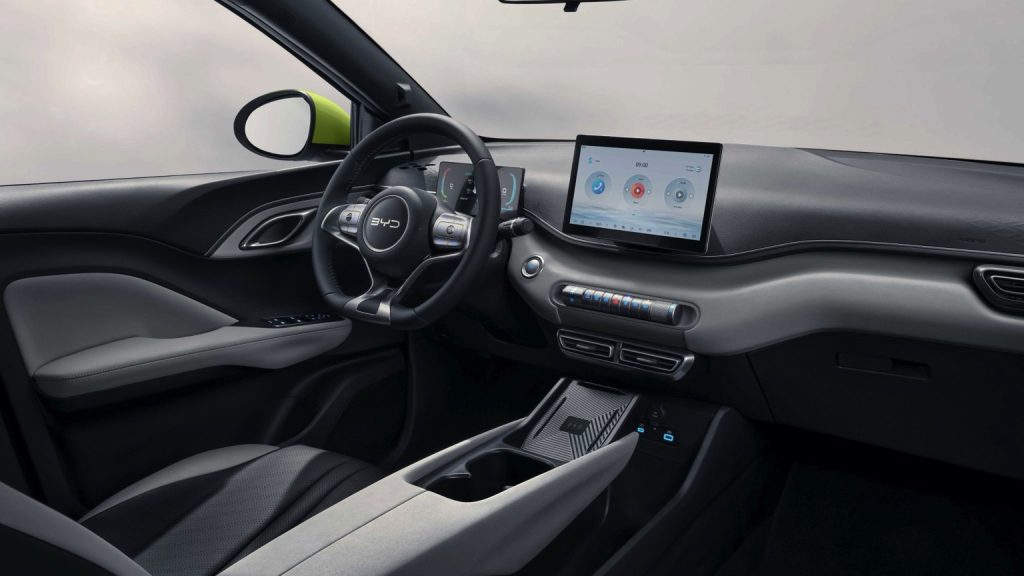
In the meantime, the Nissan Leaf takes a more traditional, grounded approach. It has the look and feel of a conventional car, only it’s electric. The lines are smoother and less cluttered than the Dolphin’s, catering to an older demographic that appreciates modesty and dependable quality rather than extreme design. It is not the wheel that is being reinvented, it is the wheel being refined. Inside, the Leaf is more button-heavy and conventional in its layout than the minimalist, screen-focused Dolphin cabin, again underlining the generational gap between who they are designed for.
The two models are direct competitors for the practical shopper, a driver seeking a dependable daily driver without the inflated sticker prices of a Tesla or Polestar. The Leaf provides the certainty of something like “a safe bet” in the EV world. For a comparable, and in many cases, lower price point, the Dolphin offers the appeal of the new, with more modern tech and a newer face.
BYD Dolphin vs. Nissan Leaf Spec Sheet Appendix
| Specification | BYD Dolphin (44.9 kWh Variants) | Nissan Leaf SV Plus (62 kWh) |
|---|---|---|
| Battery Capacity (Usable) | ~44.9 kWh | ~59 kWh |
| Motor Power | 70 kW (Active) / 130 kW (Boost) | 160 kW |
| Horsepower | ~94 hp / ~174 hp | ~214 hp |
| Torque | 180 Nm / 290 Nm | 340 Nm |
| 0-100 km/h | ~10.9s / ~7.0s | ~6.9s |
| Top Speed | ~150-160 km/h | ~157 km/h |
| Drivetrain | Front-Wheel Drive | Front-Wheel Drive |
| Charging (AC) | 7 kW / 11 kW (Optional) | 6.6 kW |
| Charging (DC Fast Charge) | Up to 60 kW | Up to 100 kW |
| Length | 4,290 mm | 4,490 mm |
| Width | 1,770 mm | 1,788 mm |
| Height | 1,570 mm | 1,540 mm |
| Boot Space | 345 litres | 420 litres |
When Shopping for Electric Vehicles
When shopping for electric vehicles, the spec sheet only tells you so much. Then it’s time to get it out on the road. In this part of our Dolphin SURF 43.2 kWh Boost 2025 Review, we take a look at exactly what performance on the water is like. What are we comparing the young upstart to the grizzled veteran for: driving fun?
Both the BYD Dolphin SURF 43.2 kWh Boost and the Nissan Leaf are meant for city commute first and foremost, but achieve this in two very different ways, engineering-wise. The Dolphin, in terms of character, is more spirited, almost playful, while the Leaf is smoothness and serenity to the nth degree. Let’s take a look at the specs and the road feel of these two rivals.
BYD Dolphin SURF 43.2 kWh Boost vs Nissan Leaf Performance & Driving Experience
On the other hand, the BYD Dolphin SURF 43.2 kWh Boost has a permanent magnet synchronous motor on the front wheels. This configuration produces a zesty 130 kW (~174 hp) and 290 Nm of torque. It is paired with a single-speed transmission delivering immediate, uninterrupted power. The acceleration from 0 to 100 km/h is in the vicinity of 7.0 seconds, which is very good for this class. The top speed is limited to 160 km/h, which is more than enough for the highway.
Driving the Dolphin feels agile. The steering is light, possibly too light for purists, but perfect for negotiating tight city streets and parking garages. The suspension – MacPherson struts up front and a multi-link rear beam – is set up for comfort, but can take bends surprisingly well. You can sense the low centre of gravity the Blade Battery provides, which keeps the car grounded as you make spirited manoeuvres.
The Nissan Leaf, in particular the comparable SV Plus model, has a 160 kW (214 hp) motor with 340 Nm of torque. This gives it a slight advantage in terms of power, and it will do 0-100 km/h in about 6.9 seconds. It’s also electronically limited to around 157 km/h. Like the Dolphin, linear acceleration is achieved through a single-speed reduction gear transmission.
On the road, the Leaf is substantial and confident, solid and mature in its execution. It is so smooth and absorbed that you would never imagine how much money he spent on it. The steering is a bit heavier and provides more feedback than that of the Dolphin, allowing the driver to feel more connected to the road. It feels heavier in the corner, though; it’s not as “tossable” as the lighter Dolphin. The suspension is soft-tuned to favour passenger comfort over sporty dynamics.
Performance & Driving Experience Comparison
The difference in driving philosophy is even more evident when considering the total power and driving modes. The Dolphin SURF takes full advantage of its 130 kW motor, with its lightweight, feeling zippy and responsive from the get-go. It also has a few distinct driving modes (Eco, Normal, Sport) with fairly noticeable differences in throttle response. Sport mode does impact the feel of the pedal quite a bit, which I’m a huge fan of, as it makes joining motorways much easier.
The Leaf’s “e-Pedal” is a key selling point here. It enables genuine one-pedal driving, applying regenerative braking to stop the vehicle fully without the requirement to press the brake pedal. This changes the driving experience in stop-and-go traffic, from exhausting to relaxing. While the Dolphin has settings for regenerative braking, they are not as aggressive or as intuitive as the Leaf’s system.
| Feature | BYD Dolphin SURF 43.2 kWh Boost | Nissan Leaf SV Plus (62 kWh) |
|---|---|---|
| 0–100 km/h | ~7.0 seconds | ~6.9 seconds |
| Top Speed | 160 km/h | 157 km/h |
| Power Output | 130 kW (174 hp) | 160 kW (214 hp) |
| Torque | 290 Nm | 340 Nm |
| Driving Modes | Eco, Normal, Sport | Eco, Normal (plus e-Pedal) |
| Suspension Feel | Agile, comfort-biased but firm | Plush, stable, and absorbent |
| Braking Tech | Standard Regen (2 levels) | e-Pedal (One-pedal driving) |
The Dolphin’s multi-link rear end provides superior handling stability on rough roads over traditional torsion beams. The multi-link rear suspension of the Dolphin provides superior handling stability on rough roads over traditional torsion beams.
Nissan’s e-Pedal makes it easier for drivers to coast in stop-and-go traffic; that’s big news for daily commuters.
The Dolphin SURF’s 290 Nm of instant torque makes overtaking effortless and brings confidence on the highways.
The Leaf’s heavier steering weight gives it a reassuring “big car” feel on the highway.
Final Thoughts on Performance
That’s where the emotional connection really kicks in when you get in a car. In this most discerning aspect of our review of the Dolphin SURF 43.2 kWh Boost 2025, we look into the interiors of two very different EVs. It’s in the cabin that you while away your time, find the intersection of comfort and function, and get yelled at by screens and software for your distracted ways.
The BYD Dolphin SURF 43.2 kWh Boost and Nissan Leaf are in stark contrast when it comes to cabin design. One looks like a futuristic lounge created by a tech startup; the other feels like a high-end, institutional space designed by automotive experts.
Comfort, Ergonomics, and Storage
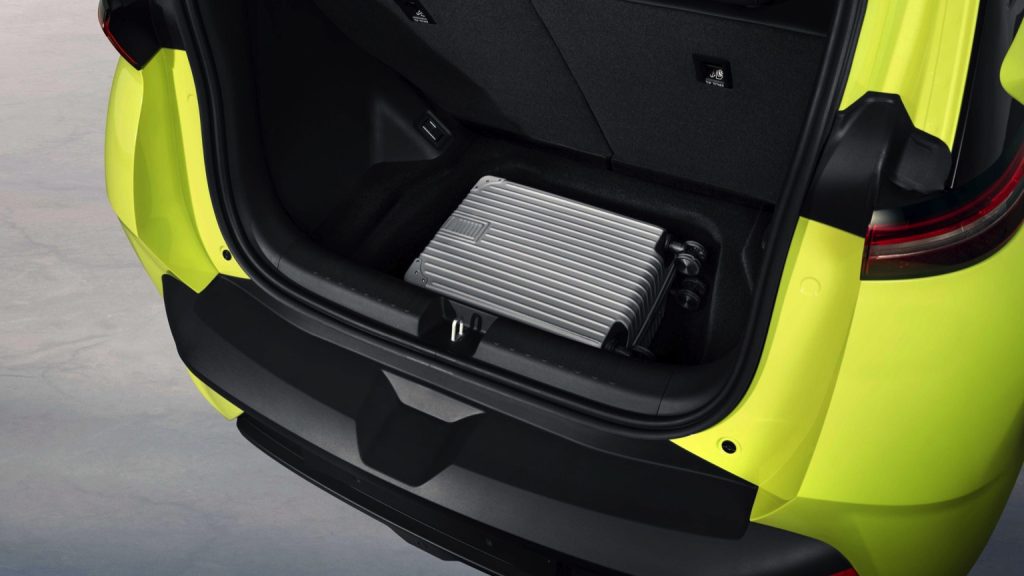
Even for a small car, the Dolphin SURF is surprisingly comfortable. The front sports seats are one-piece construction, and the headrests are fixed, which provides good lateral support when cornering. They have power adjustment and heating in the upper grades. The flat rear-seat floor made possible by the dedicated EV platform facilitates a fairly comfortable ride for three adults who will find legroom there that punches higher than its weight. The clever storage includes a large open tray beneath the centre console, big enough for a handbag or a small rucksack, plus deep door bins.
The Leaf makes its case with the famous “Zero Gravity” seats. These seats are extremely comfortable and designed to minimise fatigue by supporting the body continuously from the hips to the shoulders. They feel plush and warm, cosy, making the Leaf an excellent partner for long commutes. Yet the backseat is narrower than that of the Dolphin. The tall centre tunnel, an artefact of the platform’s previous composition, encroaches on the occupant’s legroom in the middle. At 435 litres, the boot space is ample, which outshines the Dolphin’s 345 litres, making the Leaf the better carrier for grocery runs or airport rides.
Tech Innovations and Connectivity
It is really in technology that the Dolphin SURF 43.2 kWh Boost shines. The DiLink OS is essentially an Android tablet on wheels. You can install third-party applications, stream video (while stationary) and interact with a smart voice assistant that recognises natural language commands like “I’m too hot” to cool down. Apple CarPlay and Android Auto are wireless for seamless smartphone connectivity.
The Nissan Leaf may appear to be less of a gadget, but its tech is designed to help you drive. The NissanConnect feature is comprehensive, enabling remote climate control as well as charging status through a phone app. Its ace in the hole is the ProPILOT Assist system (on upper trims). This high-tech driver-assistance feature (ADAS), which pairs adaptive cruise control with steering assist to keep you centred in your lane, can remove a big chunk of stress from highway driving. The Dolphin has the same ADAS stuff, lane-keep and adaptive cruise, but the Leaf implementation just seems a little cleaner and more natural on the road.
The rotating screen on the Dolphin enables navigation in portrait mode, letting you look further down the road and not just to the left and right.
Nissan Zero Gravity seats deliver the ultimate comfort in long-distance travel by alleviating back fatigue on long voyages.
The Dolphin’s flat rear floor turns the back seat into a truly practical place for three passengers.
Climate and volume have physical buttons that allow you to make adjustments without taking your eyes off the road.
BYD Dolphin SURF 43.2 kWh Boost vs Nissan Leaf Design and Exterior
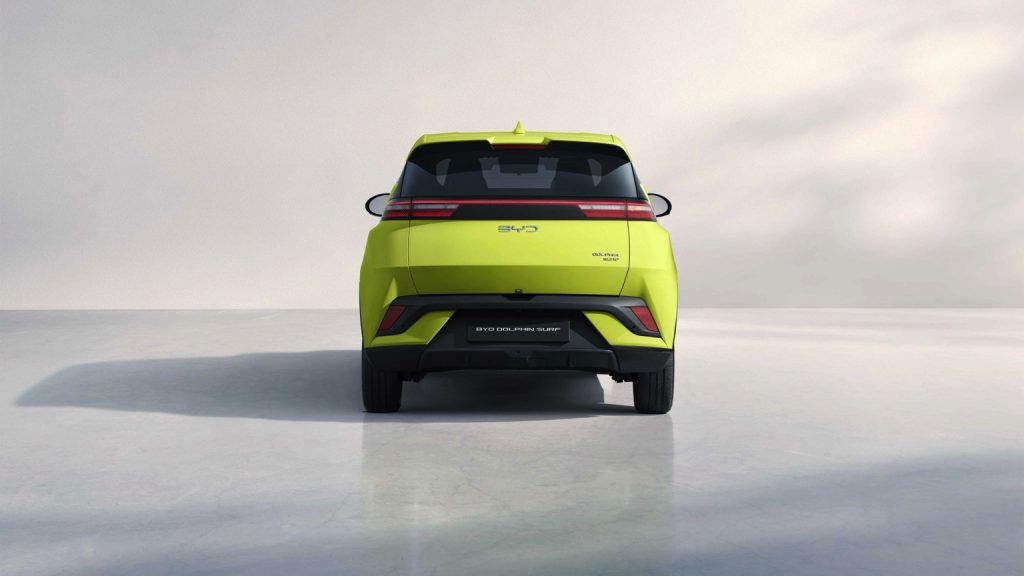
In this part of our Dolphin SURF 43.2 kWh Boost 2025 Review, we take a look at the bodywork. The shape and design of a vehicle’s exterior is about more than just catching the eye; it tells the vehicle’s purpose, affects its efficiency, and gives it road presence. The BYD Dolphin SURF and Nissan Leaf have two separate design languages, one influenced by natural curves and elements, and the other by aerodynamics and wind tunnel testing.
The BYD Dolphin SURF: Ocean Aesthetics in Motion
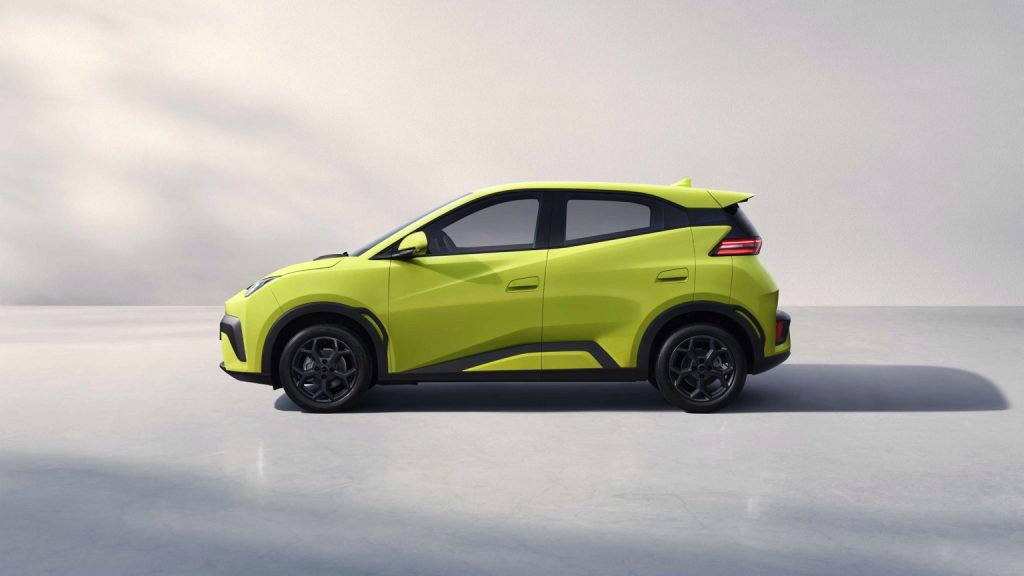
The BYD Dolphin SURF 43.2 kWh Boost is a tour de force in the marque’s design language, “Ocean Aesthetics.” This is all surface-level stuff; you can even spy the marine workouts in the actual shape of the car. The design itself takes its cue from the shape of a dolphin jumping out of water and gives the feeling of racing speed even when the vehicle is static.
The “SURF” edition turns up the aggressiveness, specifically with sharp angular cuts and patterned texture work on the C-pillar akin to dorsal fins. The front end is closed off, a common EV motif, but a continuous light bar across the front connects the headlamps, giving the vehicle a wide, futuristic look. The two-tone colour options for this trim bring a touch of youthful vibrancy to the visual weight of the automobile, accentuating the floating roof design. It has a quick, tight, and very now feel to it.
The Nissan Leaf: Sculpted by the Wind
The Nissan Leaf is a different kind of electric car. It’s an evolutionary design that has been developed and refined over years of analysing the way air flows over the surface of a car. While the Dolphin typically looks “organic,” the Leaf, by comparison, looks “technical.” It features a slanted, V-Motion front grille (now replaced by a flush panel for the EV age) that flows into a sleek, aerodynamic hood.
Every crimp in the Leaf has a function. The rear diffuser and the uniquely sculpted headlights are built to direct airflow away from the side mirrors and decrease drag, which indirectly helps with its range efficiency. The profile is bang-on hatchback, meanwhile, with a floating roof effect created by blacked-out pillars, which lends a modern twist to a profile that’s all about practicality and visibility. It conveys an image of maturity and tested reliability.
Architectural Breakdown
Both cars are based on dedicated platforms that dictate their exterior dimensions. Sitting on BYD’s e-Platform 3.0, the Dolphin redefines the potential of urban electric vehicles with ultra-short overhangs and a long wheelbase for its size. This “wheels-at-the-corners” stance not only maximises interior volume but gives the exterior a planted, sporty look.
The Nissan Leaf uses a platform that has been significantly adapted to electrification over the course of its existence. A more traditional bonnet length, it retreats just a fraction lower to the earth beneath. That gives it classic car proportions that many buyers find reassuringly familiar compared to the “cab-forward” layout of most modern EVs.
| Feature | BYD Dolphin SURF 43.2 kWh Boost | Nissan Leaf (SV Plus / e+) |
|---|---|---|
| Design Philosophy | “Ocean Aesthetics” – Organic, fluid lines inspired by marine life and waves. | “Intelligent Mobility” – Technical, sharp, and focused on aerodynamic efficiency. |
| Lighting Signature | Continuous LED light bar across the front grille; geometric “dolphin fin” taillights with a distinct weaving pattern. | Boomerang-shaped LED daytime running lights; signature vertical rear taillights that frame the rear window. |
| Aerodynamics | Smooth, sealed front face with active air intake shutters; flush door handles to reduce drag. | Drag coefficient of 0.28; underbody covers and rear diffuser designed to smooth airflow and reduce wind noise. |
| Body Detailing | Two-tone body options with contrasting roof and bonnet; textured C-pillar “fin” design. | Floating roof design with blacked-out pillars; iconic V-Motion front panel in blue/black contrast. |
| Wheel Design | 17-inch alloy wheels with a tri-colour, geometric design designed to reduce air resistance. | 17-inch 5-spoke machine-finished aluminium-alloy wheels for a sporty, premium look. |
| Colour Palette | Vibrant and playful: Atlantis Grey, Surfing Blue, and Peach Pink (often two-tone). | Sophisticated and grounded: Pearl White, Gun Metallic, Scarlet Ember, and Deep Blue Pearl. |
Peace of Mind: Safety Tech and Proven Reliability
When you’re shopping for a car to haul your family around or spin in during your daily commute, the glitz of touchscreens and the thrill of acceleration often take a backseat to one fundamental question: Is it safe? Here in this section of our Dolphin SURF 43.2 kWh Boost 2025 Review, we take a closer look at the protective shells and electronic guards of our two finalists.
There is no doubt that the BYD Dolphin and the Nissan Leaf both put a strong emphasis on safety, but they belong to different decades of automotive design. One is based on the most recent architectural advances, and the other is built on a decade of real-world validation.
Safety & Reliability
The BYD Dolphin SURF 43.2 kWh Boost gains a lot from being based on the e-Platform 3.0. This new generation platform has been purpose-built for EVs with crash energy absorption routes optimised in ways that previously modified platforms are unable to accommodate. A significant element of its safety profile is the Blade Battery. Contrary to conventional lithium-ion packs, the Blade Battery is made of lithium iron phosphate (LFP) chemistry and a novel structural design, which makes it highly resistant to thermal runaway. In nail penetration tests, the “Mount Everest” of battery safety testing, the Blade Battery does not emit smoke or ignite, providing a degree of reassurance that’s difficult to match in the EV space.
As for the ratings, the BYD Dolphin has already received a 5-star Euro NCAP safety rating thanks to the high-strength structure and active safety systems. It is fitted with a full complement of airbags, including a front-centre airbag that stops the driver and passenger from making contact in a side impact, a device which is normally only found in high-end luxury cars.
The Nissan Leaf, meanwhile, carries the torch of an elder. Since it has been on the road for more than 10 years in its various forms, it has well-established safety credentials. The current generation Leaf has also received high safety scores from multiple regions around the world, earning a 5-star Euro NCAP rating and being named a Top Safety Pick by the IIHS in the US. Its bodywork is rigid and solid, which ensures good protection for the passengers. True, it employs more conventional lithium-ion battery chemistry than BYD’s LFP technology, but Nissan’s battery management system (BMS) has the highest reputation for reliability, and 98 per cent of batteries that do not fail are driven across millions of kilometres worldwide, making it one of the most reliable BMS systems globally.
Intelligent Guardians: ADAS and Active Safety
Safety in the modern era is no longer just about being able to survive a crash; it’s about not having one in the first place. So, when do we get to ADAS (Advanced Driver Assistance Systems)?
The Dolphin SURF is equipped with a standard impressive list of ADAS features, usually grouped under “DiPilot.” It comprises:
- Adaptive Cruise Control (ACC): Automatically maintains a safe distance from the vehicle in front.
- Lane Keeping Assist (LKA) & Lane Departure Warning (LDW): Softly nudges your vehicle back if you are drifting outside of your lane without signalling.
- Automatic Emergency Braking (AEB): Recognises pedestrians and bicyclists, braking if a collision is pending.
- 360-degree Camera: Offers a bird’s-eye view for easy parking in tight spaces.
The Nissan Leaf is a formidable contender with its best-in-class ProPILOT Assist (offered on SV Plus and higher trims). Although the feature set is similar to intelligent cruise control, steering assist, and emergency braking, the Leaf implementation is incredibly polished. It activates smoothly, tracks lanes with a natural feel, and you are confident following it. It also includes Rear Auto Braking, which comes in handy in a hectic parking lot; it senses an object that is not moving behind you and brings your car to a stop to avoid a rear-end collision.
Reliability and Long-Term Ownership
Reliability is safety’s silent partner. The Nissan Leaf shines brightly here. Nissan has had years to iron out the kinks as one of the first mass-market EVs. That powertrain is said to be bulletproof, and while the build quality is simpler, it’s good enough to take a beating on a daily basis. It is the “safe pair of hands” in the EV universe, predictable, rugged, and backed by a vast dealer network that understands the car inside and out.
The BYD Dolphin, as a new player, doesn’t have the same decade-long track record. But BYD’s not a startup; they are one of the world’s largest battery manufacturers. Vertical integration means they manufacture pretty much every component internally, from chips to batteries, which means they can exercise tight quality control. Initial reports and owner reviews indicate very high reliability, particularly for the battery and powertrain, though the long-term durability of the in-cabin electronics is a question the market is still debating.
- Feature: BYD Blade Battery Technology.
Benefit: Significantly reduces fire risk and enhances structural rigidity for better crash protection. - Feature: Nissan’s Rear Automatic Braking.
Benefit: Helps avoid expensive low-speed collisions while backing out of driveways or parking spaces. - Feature: Dolphin’s Standard 360-degree Camera.
Benefit: Eliminates blind spots while parking to protect your alloy rims and bumpers from touching the curves and scratches. - Feature: Nissan’s far-reaching service network.
Benefit: If anything does go wrong, you can get help and parts for your car just about anywhere.
Market Rivals: How the Dolphin and Leaf Stack Up Against the Competition
Compact electric cars are popular, and this is where BYD Dolphin SURF 43.2 kWh Boost, Nissan Leaf, and many more are competing, but they do stand out. In order to be truly absolute about everything about Dolphin SURF 43.2 kWh Boost 2025 Review, we have to look far and look wide. How do these two stack up against other segment heavyweights like the MG4 and the Ora Funky Cat (GWM Ora 03)?
This is the data dissection section, to see where the money really moves. We go beyond the brochure highlights to compare the prices, the performance and the practical range to give you a clear view of the market ladder.
| Feature | BYD Dolphin SURF 43.2 kWh Boost | Nissan Leaf (SV Plus) | MG4 Excite 51 | GWM Ora 03 (Funky Cat) |
|---|---|---|---|---|
| Price Range (Est.) | Competitive / High Value | Mid-Range / Established | Competitive | Premium Niche |
| Battery Size | ~44.9 kWh (Blade) | 62 kWh | 51 kWh | 48 kWh |
| WLTP Range | ~310–340 km | ~385 km | ~350 km | ~310 km |
| Power / Torque | 130 kW / 290 Nm | 160 kW / 340 Nm | 125 kW / 250 Nm | 126 kW / 250 Nm |
| 0–100 km/h | ~7.0 sec | ~6.9 sec | ~7.7 sec | ~8.3 sec |
| Drive Layout | FWD | FWD | RWD | FWD |
| Charging (DC) | 60 kW | 50/100 kW (CHAdeMO) | 88 kW | 64 kW |
| Key Strength | Tech & Standard Equipment | Comfort & Pilot Assist | Driving Dynamics | Retro Styling |
Value, Performance, and Design Analysis
Price and Value
The Dolphin SURF 43.2 kWh Boost is off to an aggressive start. It routinely bests its competitors’ prices and then some, all while packing a standard equipment list the others make you pay for, including a 360-degree camera and electrically adjustable seats. When priced higher, the Nissan Leaf retains its value because of the strength of the brand and a very enthusiastic fan base. The MG4 is the best contender for the Dolphin in terms of value for money, and arguably also value for range, whereas the Ora appears to ask a premium for its distinctive look rather than raw specs.
Performance and Dynamics
This is where the Dolphin SURF surprises many. Its 0–100 km/h time is about 7.0 seconds, which makes it faster than the ordinary MG4 and Ora Funky Cat. Despite having a smaller battery and motor, it accelerates as fast as the more powerful Nissan Leaf SV Plus, thanks to its lighter weight. The MG4 should be a dream for enthusiasts, being rear-wheel-drive, giving it a much better balance, but the polar opposite Dolphin’s front-wheel-drive setup is more forgiving for the general driver in less than ideal conditions.
Range and Practicality
The Nissan Leaf SV Plus wins the range crown in this comparison, due to its bigger 62 kWh battery. It is the better option for longer highway drives. With its ~44.9 kWh pack, the Dolphin is at home in the city and suburbs. It’s suitable for making inter-city trips, but you’ll be stopping to recharge more frequently than with the Leaf. However, the charging curve of the Dolphin is relatively flat, and the charging time is short, within several seconds, by using maximum 60 kW charging.
Design Philosophy
Design is subjective, but clear. It’s modern and “techy,” and the target market is a younger generation that grew up with smartphones. The Leaf is conventional and safe, designed to blend in rather than stand out. The Ora caters for the extrovert who wants to be noticed, while the MG4 is neat and aggressive. The Dolphin sits comfortably in the middle; it’s unique enough to be cool but rather practical and usable.
Buyer Suitability
So who should buy what?
- The Tech-Savvy Urbanite: The BYD Dolphin SURF 43.2 kWh Boost is your car. If you want to have the latest bells and whistles, a responsive screen, and a car that feels peppy while you’re waiting to get through traffic lights, this is the unbeatable value pick. It is also targeted at consumers who value “fun per dollar” and modern connectivity rather than long-distance cruising range.
- The Comfort-Seeker & Commuter: The Nissan Leaf is still the king of comfort. If you’re looking for a no-stress ride, soft seats, and a silent cabin, the Leaf is worth the extra cost. It is suitable for older consumers or small families who just want a reliable, “normal” car that is electric and doesn’t require them to learn a new way of driving.
- The Driving Enthusiast: If handling is your most critical attribute, it’s possible the MG4 (RWD) could swipe some of your attention, although the Dolphin SURF is amazingly good in a straight line.
- The Style Icon: Should cars be fashion accessories, the Ora Funky Cat emerges as the most attractive one, yet you lose a bit of performance and value against the Dolphin.
Choosing Your Champion: Why the Dolphin or Leaf Makes Sense
Switching to an EV is about more than just picking a new car; it’s about choosing a new daily life partner. As this BYD Dolphin vs Nissan Leaf Review has illustrated, both the Nissan Leaf and the BYD Dolphin have strong cases, but they appeal to very different priorities and ways of life. To know their fundamental differences and how that fits with the manufacturer’s more general plan is to know which one is better suited to your needs.
The BYD Dolphin SURF 43.2 kWh Boost symbolises BYD’s aggressive approach to reach into the mass market with high-tech EVs. The company draws on its experience as a battery manufacturer to introduce capabilities and performance that until now had been available only in high-end vehicles. The Dolphin has been created for a new generation of driver who expects their car to be as smart, connected and efficient as they are via their smartphone. It is the ultimate vehicle for city dwellers who want to stay agile, make use of the latest technology, and get noticed, all without breaking the bank. Its instant torque and compact size make it a joy to drive in the city, where it excels in the stop-and-go of city streets.
Meanwhile, the Nissan Leaf represents a core part of Nissan’s “Intelligent Mobility” philosophy, which seeks to provide a seamless, safe and sustainable driving experience. Its strategy relies on the core of trust and proven reliability. The Leaf is for the pragmatic, destination-minded buyer who just wants a comfortable, friendly, and utterly reliable car to drive around town. It’s an excellent choice for the daily runner outside the city, the small family seeking a no-nonsense second car, or anyone brand new to EVs who just wants a gentle introduction. Leaf performs especially well on longer commutes and highway travel, as its soft ride and ProPILOT Assist system greatly diminish driver fatigue.
Pros of the BYD Dolphin SURF 43.2 kWh Boost
The success of the Dolphin is based on its excellent value and the most advanced design. Its best feature is the rich bundle of features at an aggressive price. You get a car that feels new and exciting, with a laundry list of standard features that many competitors offer as pricey options. The lively performance of the Boost variant makes everyday driving enjoyable, while the revolutionary Blade Battery technology offers a basic level of safety and solace that’s difficult to put into words but easy to understand. It is the best seller for those who want to drive the future, today.
Pros of the Nissan Leaf
The best thing about the Nissan Leaf is its established track record. After more than ten years on the market and millions of miles driven around the world, it is a known quantity. Its powertrain and battery are famously reliable, and that level of peace of mind still isn’t quite available for newer models. This is complemented by its exceptional ride comfort owing to the “Zero Gravity” seats and sprung-for-serenity, attention-tuned suspension. For drivers who want a calm and low-stress ownership experience, supported by an extensive and knowledgeable dealer network, the Leaf continues to be one of the most practical and best bets you could make in an electric vehicle.
The Final Decision: Which EV Wins in 2025?
After complete test riding, the choice between a BYD Dolphin and the Nissan Leaf is surprisingly easy in this BYD Dolphin SURF 43.2 kWh Boost 2025 Review. It’s not a matter of which vehicle is better, but rather which vehicle is better for you. Both cars deliver great value and are worthy challengers in the electric vehicle space, but they cater to two very different demographics.
If you’re a technology enthusiast and a BYD Dolphin SURF 43.2 kWh Boost lover who just wants a good time in a spirited, fun-to-drive car, the BYD Dolphin SURF 43.2 kWh Boost is definitely a must-buy. It’s the contemporary option for city life, with a sensational array of standard equipment, zippy turning-out-of-the-door performance, and forward-looking styling at its cost. If your commutes are mainly city-bound, if you’re a driver who appreciates a car that is much like a smart device on wheels, and you want to feel like you’re getting more than what you paid for, the Dolphin is a wise purchase. This is the car for people who love the new and want their vehicle to be a conversation starter.
On the flip side, the Nissan Leaf is the practical choice for the buyer who values comfort, proven reliability and a hassle-free ownership experience. It is also worth buying if you just want a plush, quiet ride that won’t tire you out on long drives and the peace of mind that comes with a decade of real-world data. The Leaf is ideal for EV novices looking for a mild introduction to a new driving format, or for families in need of a reliable, safe vehicle that doesn’t require them to learn complex new skills in the process. And if you crave that ‘‘get in and go’’ simplicity of purpose, and comfort that comes from the backing of a long-established automotive giant, the Leaf is still an extraordinarily intelligent and practical buy.
Take the Next Step
In the end, there’s no substitute for driving the car to decide which is best. There’s only so much reading reviews can do for you, and what really matters is when you feel the instant torque, navigate the infotainment system, and experience ride comfort yourself.
Are you ready to try the next generation of urban mobility? Get in touch with us if you want to know more about the BYD Dolphin SURF 43.2 kWh Boost and arrange your test drive in The.Car. See how its combination of technology, performance and value can change your drive every day.